
Blogs
- Home
- Blogs
What is Incoterms
Incoterms or international commercial terms are a set of trade terms created by the International Chamber of Commerce (ICC) to help smooth out the complexities of international trade. These standardized terms clearly clarify who does what in terms of shipping, insurance, customs clearance and when the risk of loss or damage shifts from the seller to the buyer.
In this guide, we will list out 11 of the Incoterms 2020, covering their applications, and how to practically use them in your global trade operations. Whether you’re an importer, an exporter or a freight forwarder, this is the go-to guide for getting a grip on the rules of international trade.
The Basics of Incoterms
Incoterms are just three letter trade terms (like FOB, CIF, EXW) that sort out who does what in any international sales contract. They prevent disputes by making it crystal clear who pays for what, when and where and when the risk of loss or damage passes from the seller to the buyer.
This process can take longer than domestic shipping and may include extra costs like duties and taxes.
Where Did Incoterms Come From?
The International Chamber of Commerce first came up with Incoterms all the way back in 1936 as a way of standardising the fragmented national practices that were causing so much confusion in international trade. Since then, we’ve had nine revisions including major overhauls in 1990, 2000, 2010 and 2020 – that have seen the rules evolve to address containerisation, security requirements and the need for multimodal transport.
What Do Each of the Incoterms Do?
Each incoterm establishes three key things:
- Risk allocation: Exactly where the buyer’s risk begins
- Cost distribution: Who pays for transportation costs, insurance and customs clearance process
- Documentation: What kind of delivery obligations both parties need to meet
How the Incoterms 2020 Classification System Works
Incoterms 2020 groups eleven terms into two categories based on their applicability to different modes of transport.
Rules for Any Mode of Transport (7 Terms)
Term | Risk Transfers | Seller’s Responsibility |
EXW (Ex Works) | At seller’s premises | Minimum—buyer assumes all costs |
FCA (Free Carrier) | To buyer’s carrier | Export clearance included |
CPT (Carriage Paid To) | At carrier handover | Seller pays transport to destination |
CIP (Carriage and Insurance Paid) | At carrier handover | Transport plus insurance paid by seller |
DAP (Delivered at Place) | At named place of destination | Seller covers delivery costs to destination |
DPU (Delivered at Place Unloaded) | At place unloaded | Seller bears unloading responsibility |
DDP (Delivered Duty Paid) | At destination | Maximum obligation—seller pays import duties |
Under DDP delivered duty paid terms, the seller is responsible for all the costs including import customs duties—the highest level of seller’s obligation in international trade terms.
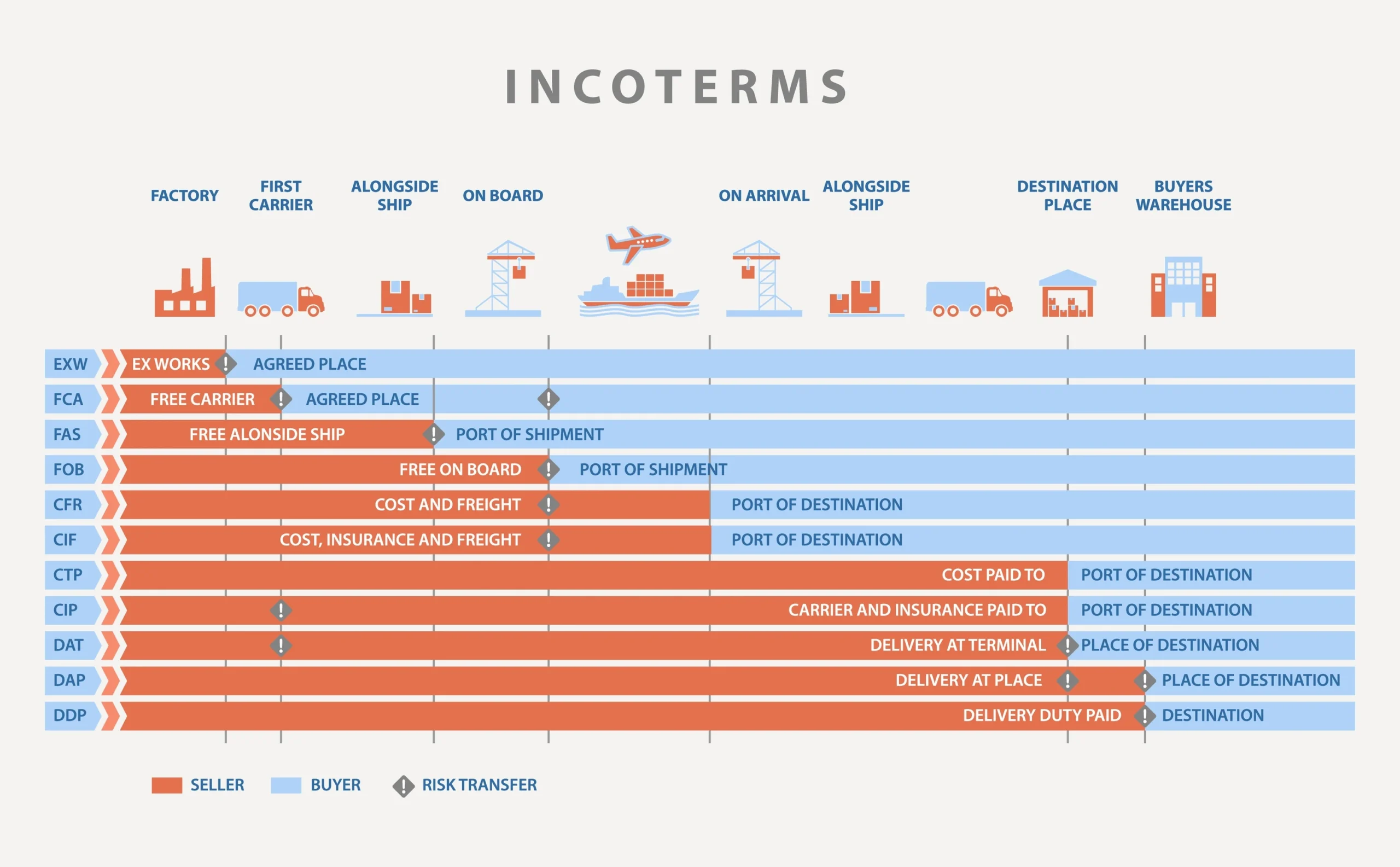
Rules for Sea and Inland Waterway Transport (4 Terms)
Term | Application | Key Feature |
FAS (Free Alongside Ship) | Breakbulk cargo | Seller delivers alongside vessel |
FOB (Free on Board) | Non-containerized goods | Risk passes when loaded on board |
CFR (Cost and Freight) | Sea freight | Seller pays freight costs to destination port |
CIF (Cost Insurance and Freight) | Sea freight | Cost insurance and freight covered by seller |
Terms like CIF and FAS apply only to sea and inland waterway transport – not to containerised cargo. For that, you’re better off going with FCA and CIP.
Risk and Insurance Requirements
Getting to grips with when risk transfers is crucial when it comes to insurance decisions. On terms like CPT and CIP, the seller pays for carriage to the destination place, but risks transfers at carrier handover, creating a gap you need to sort out.
Under CIP and CIF terms, the seller is also required to take out insurance under Institute Cargo Clauses (A) standards in Incoterms 2020. For any other terms, it’s up to the buyer to get their own insurance in place, as the seller’s obligation ends at delivery.
Common Challenges and Solutions
The common challenges that intercoms don’t cover include:
- Transfer of ownership, or payment negotiated terms
- Dispute resolution mechanisms or breach remedies
- Specific import clearance procedures in the buyer’s country
Choosing the Wrong Term
If you’re using FOB or CFR for containerised shipments, that creates problems with risk gaps at terminals. The 2020 revision explicitly discourages this practice – and now recommends FCA with Bill of Lading notation for container trades instead.
How to Put Incoterms into Practice
- Specify the exact location (e.g. “FCA Chicago O’Hare ORD”)
- State “Incoterms 2020” in your contracts explicitly
- Make sure insurance coverage matches risk transfer points
- Check that export clearance and import clearance responsibilities are all taken care of
Get your Incoterms selection right, and you’ll be clear on when the buyer pays and when the seller bears the costs avoiding costly disputes in global trade.
Conclusion
Ensure both parties have a clear understanding of who does what in international trade. Proper incoterm selection is key to avoiding costly disputes and making global trade a smoother process.
- Give the current contracts a good going over to make sure the Incoterms are clear-cut
- Double-check that your insurance is matched up with the term’s risk transfer point – this is super important
- Update all the references to Incoterms 2020 – time to bring them into the 21st century
For some related guidance, have a look at freight forwarding services, international shipping documentation, and customs clearance procedures.
Share Now:

Alphamol Sebastian
Alphamol is a content strategist with over five years of experience. Based in the UAE, she specialize in creating insightful and engaging articles for diverse industries, including specialized retail, professional services, and consumer product brands.
Categories
Recent Posts
Subscribe To Newsletter

Quick Links
Get In Touch
- Tilden Block 8 Room 2, AVIANCE Cargo Village Kotoko International Airport
- Block B -B46-019 Rolex Tower Business Bay Dubai, UAE
- +233 24 742 8831
- +971 52 417 2191
- info@pentfreightservices.com
Copyright © 2025 Pent. All Rights Reserved.